How Artificial Intelligence Redefined the Role of the Modern Designer
How Artificial Intelligence Redefined the Role of the Modern Designer
Five years ago, the definition of a designer was clear:
A person who transforms ideas into visuals, works on traditional software, and spends long hours executing tasks.
Today, that definition no longer applies.
AI didn’t just change the designer’s tools it reshaped the entire role.
1. From Visual Executor to Decision Maker
The tasks that used to consume 70% of a designer’s time cutting, compositing, searching for references, early ideation can now be generated instantly using AI models.
This shift pushed organizations to focus on what truly matters:
quality, taste, vision, and creative direction.
Designers are no longer expected to “execute what they’re told.”
They are expected to set the visual direction and lead the creative decision-making process.
2. From Designer to Creative Systems Engineer
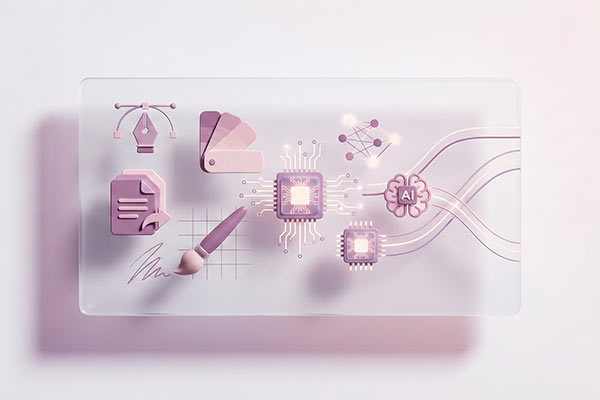
AI has transformed design into an intelligent production pipeline:
-
Generating initial concepts
-
Refining the visual direction
-
Producing variations
-
Selecting the best outputs
-
Finalizing and integrating through professional software
Design is no longer a series of isolated tasks it is a structured system built for efficiency and consistency.
This evolution positioned the designer closer to a Creative Systems Engineer rather than a traditional artist.
3. A New Core Skill: Prompt Engineering
Prompt Engineering is not a side skill.
It is a new language for communicating with AI-driven tools.
A modern designer excels not only by mastering software, but by mastering:
-
Precision in visual description
-
Understanding lighting, lenses, materials, and textures
-
Controlling details
-
Producing outputs that are production-ready
AI doesn’t replace designers—
it replaces designers who cannot communicate with it.
4. Faster Design… with Higher Responsibility
AI has accelerated the design process, yes.
But speed brings a new consequence: less room for error.
Clients now expect instant directions and immediate clarity.
Which means the designer’s responsibility has expanded to:
-
Protecting the brand identity
-
Ensuring visual consistency
-
Maintaining high standards
-
Making decisive creative judgments
In an environment that moves quickly, the cost of misdirection is higher than ever.
5. The Designer’s Real Value Is Now Strategic, Not Technical
AI has become excellent at production but terrible at understanding.
This is where designers stand out:
they bring meaning, intent, and structure to the chaos of digital automation.
Today, a designer’s true value lies in:
-
Thinking
-
Analyzing
-
Shaping identity
-
Defining direction
-
Crafting experiences
-
Building visual strategy
These are strengths no AI model can replicate.
Conclusion
AI didn’t eliminate the role of designers it elevated it.
The market is no longer looking for “designers who know the tools.”
It is looking for:
Designers who think, innovate, lead, and control intelligent systems.
Those who evolve today will lead the future of the industry.
Those who resist won’t be replaced by other designers
they will be replaced by the tools themselves.