The New Divide Designers Who Embrace AI vs. Designers Who Ignore It
The New Divide: Designers Who Embrace AI vs. Designers Who Ignore It
In just a few years, AI tools have become a fundamental part of the design industry.
But their real impact isn’t limited to the type of visuals they generate—
their greatest impact is the divide they’ve created between designers.
A divide no longer based on skill level or years of experience,
but on one thing:
how willing a designer is to embrace AI.
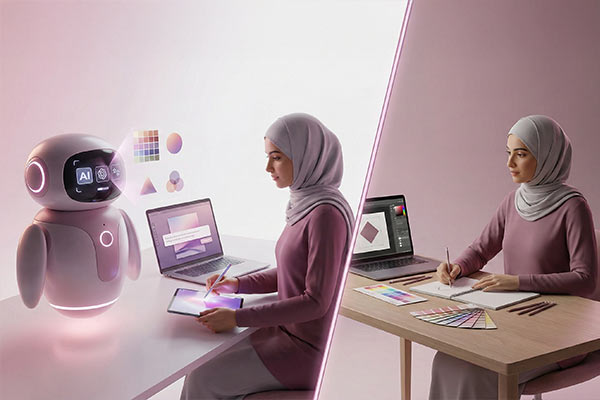
1. One Designer Works Smart… the Other Works Hard
The designer who uses AI doesn’t work less—
they simply work smarter.
They can:
-
Generate 10 directions in minutes
-
Rapidly test ideas
-
Build instant moodboards
-
Improve visual quality without losing time
-
Compress long workflows into minutes
Meanwhile, the traditional designer is still battling with:
-
Manual searching
-
Slow experimentation
-
Repetitive ideas
-
Missed deadlines
Both designers may be working on the same project…
but one races ahead,
while the other races against time.
2. The Gap Is No Longer Technical… It’s Strategic
Using AI is no longer a “bonus skill.”
It has become a core strategic component of the creative workflow.
A designer who ignores AI will find themselves outpaced in:
-
Speed
-
Quality
-
Variation
-
Innovation
-
Client responsiveness
Today, designers are measured by how well they manage tools
not just by how well they draw or execute.
3. AI Doesn’t Steal Jobs… It Steals Time
The truth is:
AI isn’t threatening the design profession.
It’s threatening the time designers need to complete their tasks.
Work that once required a week
can now be reduced to a single day.
A task that needed 10 hours
can now have its first draft in 20 minutes.
If a designer doesn’t adopt tools that match this speed,
they simply won’t keep up with the market.
4. The Value Has Shifted from “Execution” to “Direction”
AI can create visuals but it cannot choose the right creative direction.
It cannot understand brand personality,
interpret audience behavior,
or differentiate between a “beautiful design”
and a design that is strategically correct.
This is where the smart designer shines:
They lead AI rather than compete with it.
The real divide is no longer in drawing skills.
It’s between:
-
those who direct
-
and those who merely execute
-
those who understand identity
-
and those who produce pretty pictures
5. The Modern Designer Is Now a “Visual System Director”
A designer who embraces AI gains:
-
Faster production
-
Greater visual diversity
-
Enhanced quality
-
The ability to build a cohesive visual system
-
Leadership in shaping creative direction
Meanwhile, the traditional designer remains trapped inside the tools,
while others move forward to mastering the ecosystem around them.
Conclusion
The real gap today is not between “experienced designers” and “junior designers.”
It is between:
Designers who evolve with the new reality,
and designers who insist on staying in the past.
AI will not replace designers but it will replace the gap between them.
Those who embrace it will lead the future.
Those who ignore it will gradually disappear from the competitive landscape.